

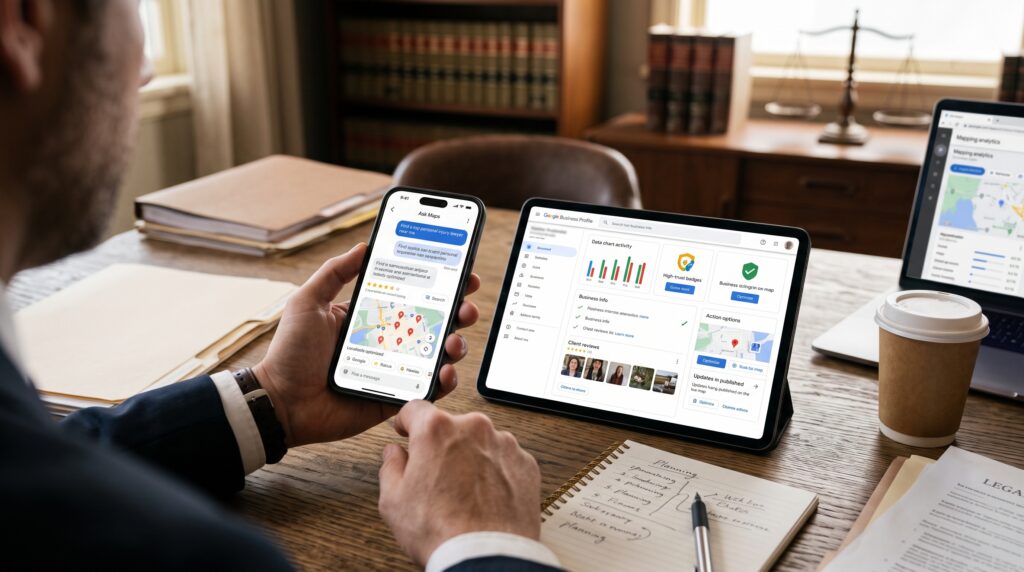
Ask Maps is Google’s conversational, Gemini-powered search layer inside Google Maps, and it changes how prospective clients find attorneys in a way most law firms haven’t adjusted for yet. Instead of typing “DUI lawyer Las Vegas” and scrolling a list, someone can now ask “who’s a criminal defense attorney near me that can meet this week” and get a personalized, AI-generated recommendation instead of a plain list of pins. A law firm’s Google Business Profile has to be structured for that kind of question, not just findable by a short keyword.
Google launched Ask Maps in March 2026, rolling out first in the U.S. and India on Android and iOS, with desktop access following. Search Engine Journal reported the feature lets users type full, natural-language questions directly into Google Maps and receive AI-generated suggestions on a personalized map rather than a standard results list. For law firms, this is the most significant shift to local legal search behavior since the local three-pack became the dominant way people found nearby attorneys.
Why Ask Maps Matters More for Law Firms Than It First Appears
Most coverage of Ask Maps has focused on restaurants and everyday local businesses, since Google’s own launch examples leaned toward queries like finding a tennis court or a coffee shop. But the underlying shift applies just as directly to legal search. A person searching for an attorney is often asking a genuinely complex, multi-condition question: which firm handles this specific charge, is available quickly, is nearby, and has a track record that looks trustworthy. That’s precisely the kind of layered question Ask Maps is built to answer conversationally instead of forcing the searcher to filter through a plain list themselves.
This shifts the competitive question for law firms from “do we rank in the local three-pack” to “does our profile give Ask Maps enough clear, structured, and current information to be the one it recommends.” A firm can have a technically complete Google Business Profile and still lose out to a competitor whose profile is more current, more specific, and easier for Gemini to confidently extract an answer from.
What Ask Maps Actually Draws On
Based on Google’s public statements at launch, Ask Maps generates its recommendations from a business’s Google Business Profile data, the volume and content of reviews, and broader location-relevant signals tied to a user’s Maps activity and search history. This means the same foundational elements that have always mattered for local SEO, an accurate profile, strong reviews, and current information, now carry even more weight, because they’re the direct inputs an AI system uses to generate a conversational answer rather than simply signals that feed a ranking algorithm.
Review content specifically becomes more valuable under this model. Ask Maps appears built to scan review text for semantic matches to a user’s specific question, not just to tally star ratings. A law firm with reviews that specifically mention responsiveness, communication, or how a case was handled gives Ask Maps concrete language to draw from when answering a conversational query like “which attorney responds quickly.” A firm with only generic five-star ratings and no descriptive review content gives the system far less to work with.
Getting a Google Business Profile Ready for Conversational Search
A few practical adjustments make a law firm’s profile more likely to surface well in Ask Maps results, beyond the standard local SEO checklist.
Complete, specific service listings matter more under a conversational model than a keyword-matching one. A profile that lists “Family Law,” “Divorce,” “Child Custody,” and “Child Support Modification” separately gives an AI system more precise material to match against a specific question than a profile listing only “Family Law” as a single catch-all service.
Recent photos validate that a business is active. Exterior shots, office interiors, and team photos, updated regularly rather than uploaded once, help confirm to both Google’s systems and prospective clients that a firm is genuinely operating and current. This same principle applies across family law firm GBP optimization specifically, where photo strategy plays an outsized role in building trust before the first call.
Google Posts and a maintained Q&A section give the system fresher, more conversational content to reference than a static profile that hasn’t been touched in months. A firm that proactively answers common questions in its own words, rather than leaving the Q&A section to strangers, gives Ask Maps cleaner material to work with.
Location pages that match the profile matter more, not less, under this shift. Linking each Google profile to a dedicated page on your site, rather than just a homepage, helps ensure that when a searcher clicks through from an Ask Maps recommendation, they land somewhere that confirms and extends the information the AI system just gave them.
What Isn’t Confirmed Yet
Google has been explicit that Ask Maps does not currently include paid placements, and recommendations are not influenced by advertising spend as of launch. That could change, and firms should treat this as the current state rather than a permanent guarantee. Google has also not published detailed ranking or selection criteria for how a specific business gets chosen for an Ask Maps recommendation over a competitor, which means firms should focus on the fundamentals Google has confirmed matter (profile completeness, review quality, current information) rather than chasing speculative tactics.
Preparing Now Instead of Catching Up Later
Ask Maps is still early. Desktop access wasn’t available at launch, and rollout beyond the U.S. and India was still pending as of the initial release. That creates a real window for law firms willing to treat their Google Business Profile as seriously as they treat their website, since the firms that build a strong, complete, review-rich profile now will likely carry that advantage forward as the feature matures and expands. Firms that wait until Ask Maps is fully mainstream will be optimizing defensively against competitors who already built the advantage, which is exactly the gap Wrangler Digital’s lawyer marketing clients are closing now.
The signals Ask Maps draws on largely overlap with what already influences AI Overviews, ChatGPT recommendations, and Gemini responses more broadly. Preparing a firm’s local profile for Ask Maps is, in practice, the same work required to stay visible across the wider shift toward AI-driven local and legal search.
Frequently Asked Questions About Ask Maps for Law Firms
What is Ask Maps and when did it launch?
Ask Maps is a Gemini-powered conversational search feature inside Google Maps that lets users ask complex, natural-language questions and receive personalized AI-generated recommendations. It launched in March 2026 in the U.S. and India on Android and iOS, with desktop access to follow.
Does Ask Maps replace the local three-pack for law firm searches?
Not entirely, at least not yet. Traditional local pack results still appear for standard keyword searches. Ask Maps adds a conversational layer for more complex, multi-condition questions, and the same underlying Google Business Profile signals influence both.
Do reviews matter more for Ask Maps than for regular Google Maps search?
Review content appears to matter more specifically, since Ask Maps seems built to scan review text for relevance to a user’s specific question rather than relying solely on star ratings. Reviews that describe specific experiences, like responsiveness or communication, give the system more to work with than generic ratings alone.
Should a Las Vegas law firm update its Google Business Profile now for Ask Maps?
Yes. Since Ask Maps draws on the same profile completeness, review quality, and current information that already matter for local SEO and AI Overviews, there’s no reason to wait. Firms that strengthen their profile now build an advantage that compounds as the feature expands beyond its current rollout.
Ask Maps rewards law firms that treat their Google Business Profile as a living, current asset instead of a one-time setup task. Request a Google Business Profile audit built for the AI search era from Wrangler Digital, or book a strategy call to see where your firm’s profile stands today.