

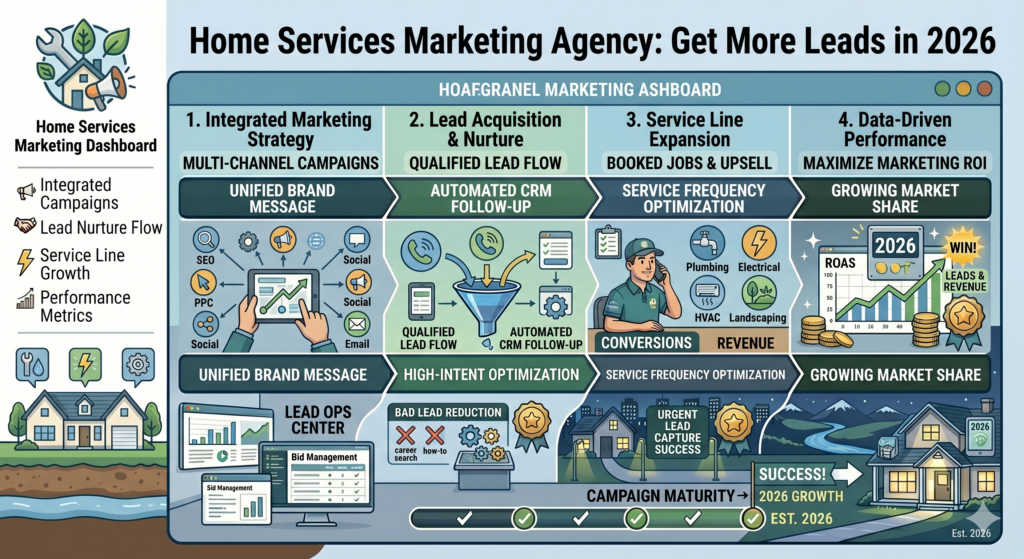
A home services marketing agency is a specialized marketing partner that helps local trades businesses like HVAC, plumbing, electrical, landscaping, remodeling, and window companies generate consistent leads through local SEO, Google Ads, website design, and reputation management. The right home services marketing agency combines trade-specific experience with measurable outcomes, so your marketing spend turns into booked jobs instead of vanity metrics. Here’s how to evaluate one, what to budget, and what to expect from the partnership in 2026.
The local lead environment has shifted significantly over the last eighteen months. Google’s Local Services Ads now occupy the most valuable pixels on a mobile search. AI Overviews answer questions before users ever click. Review velocity is suddenly a ranking signal as much as a trust signal. And the competitive pressure keeps climbing. That’s a different playing field than the one most home service owners built their marketing on five years ago, and it’s why the conversation around hiring an agency has changed, too.
Why home services marketing is its own discipline
A burst pipe at 11 p.m. isn’t something you spend time researching to find the best plumber. A homeowner whose AC failed in July isn’t going to scroll to page two of Google. They’re going to call whichever credible name they see first, and they want a human on the phone within an hour. According to Jobber’s 2026 home service trends report surveying 1,050 business owners, more than 70% of customers now expect a same-day response, and more than half expect a reply within the hour. That reality shapes every channel and every budget decision. An agency that treats your campaigns like a B2B lead-gen funnel will quietly burn through your spend.
The category is also increasingly crowded. Home services led every other business sector in new business openings in 2024, with 217,000 new companies opened on Yelp alone, up 11% year over year. That’s more competitors bidding on the same keywords, claiming the same service areas, and chasing the same reviews from the same homeowners. Standing out takes more than listing a phone number on a website.
There’s a third wrinkle unique to trades: lead quality matters more than lead volume. A roofer who books ten $15,000 jobs doesn’t want 400 tire-kicker form fills. A landscaper selling recurring maintenance plans wants homeowners, not renters. A remodeler needs permitted homeowners with a realistic budget, not someone browsing Pinterest. A good home services marketing agency understands this intuitively and builds campaigns to filter, not just fill.
Finally, this category is phone-driven. Invoca’s 2025 home services marketing research found that 84% of marketers report phone calls have higher conversion rates and larger average order values than any other engagement type, and caller retention runs 28% higher than web-lead retention. If your agency can’t track calls, attribute them to source, and measure booked jobs (not form fills), you’re flying blind.
When does hiring a home services marketing agency make sense?
Most owners know they need help when one of three things happens. Lead flow becomes unpredictable, with feast-or-famine cycles that crews can’t absorb. Marketing spend keeps climbing, but booked jobs don’t, which usually means ads are running, but nothing under the hood is working. Or the owner is simply out of hours. Running a truck, managing techs, and doing your own SEO on weekends is a recipe for doing three things poorly.
If you’re generating fewer than five qualified leads per week per truck, or your cost per booked job has climbed above 12% of revenue for that channel, it’s usually cheaper to hire an agency than to keep winging it. Below that threshold, a good in-house manager or a vetted freelancer may cover the basics.
The other trigger is geography. Expanding into a new service area doubles the complexity of local SEO overnight. Each market has its own competitors, keyword prices, review norms, and seasonal patterns. An agency with experience scaling campaigns across markets (Tucson is not Buffalo, and West Palm Beach is not Cincinnati) will compress your learning curve considerably.
What channels should a home services marketing agency cover?
A credible home services marketing agency should cover all of the channels below, or partner openly with specialists who do. Beware agencies that sell you only the one service they happen to be good at.
Local SEO and Google Business Profile
Your Google Business Profile is the single most valuable piece of digital real estate you own, because it feeds both the local map pack and Google’s Local Services Ads eligibility. Categories, services, hours, photos, posts, and review responses all influence whether you show up when someone searches “electrician near me” from their driveway.
Your agency should be actively managing your profile weekly, not just claiming it once and moving on.
Local Services Ads and Google Ads
Local Services Ads are the pay-per-lead units that sit above everything else on a mobile search, with a Google Guaranteed or Google Screened badge. They’re the single biggest lever most home service businesses aren’t pulling hard enough. Traditional Google Ads still matter for service categories outside the LSA eligibility list and for branded protection, but the ranking signals are different (budget, reviews, responsiveness, proximity) and need dedicated attention.
A good agency will split your paid budget between LSAs and classic search, layer in negative keywords aggressively, and measure by booked jobs rather than clicks. Stop wasting budget on broad-match keyword traps.
Website and conversion design
Traffic is worthless if your website doesn’t convert. Home services sites should load in under two seconds on a phone, put a tap-to-call button in the thumb zone, show trust signals (license, insurance, reviews, photos of real crews) above the fold, and have dedicated service-area pages that prove local relevance. If your agency talks about “beautiful design” but can’t show you a conversion rate, keep looking.
Reviews and reputation management
Review signals are now table stakes. Consumers check multiple review sites, weight recent reviews more heavily than older ones, and expect businesses to respond to both positive and negative feedback. A home services marketing agency should have a systematic process for earning reviews after every job, a response workflow within 48 hours, and a plan for responding to negative reviews professionally.
Email and SMS follow-up
Most home service leads don’t convert on the first contact. Some are price-shopping, some are waiting on a spouse, some are months from pulling the trigger. A good agency builds out automated email and SMS sequences to stay top of mind without being annoying, plus seasonal campaigns for existing customers (tune-ups, maintenance reminders, referral asks). Email marketing is the single highest-ROI channel most owners underinvest in.
Display and retargeting
High-ticket services (remodeling, window replacement, roofing) often involve a 30 to 90 day consideration window. Display and retargeting keep you visible during that window without blowing up your paid search budget. Our explainer on how targeted display ads work walks through the mechanics.
Paid social
Paid social sits at the bottom of the priority list for most trades, but it’s valuable for visual categories (landscaping, remodeling, window replacement) where before-and-after content sells the job before the sales call. It’s also increasingly useful on Nextdoor for neighborhood-level targeting and recommendations.
How much should you budget for a home services marketing agency?
Most home services marketing agency engagements land in the $2,500 to $15,000 per month range, depending on scope and service area footprint. Here’s a rough breakdown by business size, based on what we see in the market.
| Business size | Typical monthly marketing budget | Typical agency fee included |
| Solo operator, one service area | $1,500 to $3,500 | $500 to $1,200 |
| 2 to 5 trucks, single metro | $4,000 to $9,000 | $1,500 to $3,500 |
| 6 to 20 trucks, multi-metro | $9,000 to $25,000 | $3,500 to $8,000 |
| Multi-location, 20+ trucks | $25,000+ | $8,000 to $20,000+ |
The ad spend is separate from the agency fee in most cases. A useful heuristic: aim for 6% to 12% of gross revenue allocated to marketing when you’re trying to grow. Mature businesses with strong referral pipelines can operate closer to 4%. Brand-new businesses trying to break into a competitive market may need to push above 12% for the first 12 to 18 months to build momentum.
Watch for agencies that price everything as a flat monthly retainer without visibility into ad spend, production hours, or channel mix. Transparency beats polish every time.
What ROI should you expect?
The honest answer is that it depends on your trade, your service area, your margins, and your close rate. But here are directional benchmarks worth anchoring on.
Cost per lead in home services averages around $90 nationally across aggregated 2025 industry benchmarks, but it ranges widely. Pools and handyman services tend to run under $50, while roofing, electrical, and HVAC regularly exceed $100 per lead because competition is fierce and job values are high. Your real number will depend on your local auction, not the national average.
Cost per booked job is the metric that actually matters.
- If a $150 lead converts to a booked job at a 30% rate, your cost per booked job is $500.
- If your average ticket is $800, you’re net-positive.
- If it’s $350, you’re underwater.
An agency that isn’t reporting on this (and most don’t) is reporting on the wrong thing.
Expect local SEO to show meaningful movement in 3 to 6 months, with bigger gains at 6 to 12. Expect paid channels to generate leads within the first 30 days, though the first month usually runs hot on cost per lead while the account calibrates. Anyone promising first-page rankings in 30 days or a “magic formula” is selling snake oil.
Trade-specific playbooks and why they matter
Not every home services marketing agency understands that an electrician, a remodeler, a water treatment company, and a landscaper have completely different economics, search behaviors, and sales cycles. The keyword for an emergency electrician has 85% commercial intent. The keyword for a kitchen remodel has 30%. Those two campaigns cannot run on the same playbook. Below are the sub-vertical deep dives covering the playbook for each.
Electricians compete in one of the most expensive paid categories in home services, with CPCs regularly exceeding $12 according to 2025 benchmarks. Between EV charger installs, panel upgrades, and residential service calls, the keyword intent varies sharply.
Remodelers and general contractors face the longest sales cycles in the category. A kitchen remodel averages nine months of planning before any work begins. That requires a completely different funnel: educational content, portfolios, consistent retargeting, and a nurture sequence that doesn’t annoy.
Water treatment is an education-first sale. Most homeowners don’t know they have hard water, and most don’t know what a water softener costs. That makes it a very different campaign than emergency plumbing. Las Vegas, Albuquerque, and Tucson are particularly strong markets because of severe groundwater hardness.
Landscaping is seasonal, visual, and increasingly recurring. The best landscaping marketing builds portfolios on Instagram and Google Business Profile, then converts that attention into annual maintenance contracts.
Window and door replacement is the highest-ticket item in this cluster, often with 60 to 90 day consideration windows and significant financing involvement. Homeowners in Buffalo and other cold-climate markets are especially active given energy-efficiency incentives.
How seasonality should shape your agency engagement
Home services are brutally seasonal in most markets, and most home services marketing agencies don’t plan for it well enough. HVAC spikes in July and January. Landscaping booms in April and October. Roofing hits in the weeks after major storms. Water heater demand goes parabolic with the first cold snap of fall. Pest control is summer-weighted. Remodeling planning peaks with contract signings.
A good agency builds a 12-month calendar that front-loads budget into pre-season awareness (so you capture early shoppers), protects peak-season paid spend from auction price spikes, and uses shoulder-season months for long-game work like content, reviews, outreach, and website improvements. If your agency is running the same flat monthly budget in February as it does in July, they’re either lazy or losing you money. Both end in the same place.
The other seasonality factor is weather. Agencies serving clients in Buffalo, New Orleans, and Tallahassee need to plan for hurricane and storm response surges. Roofing, tree service, and restoration companies need to be ready to shift budget within 48 hours when a major storm hits. That’s operational agility that most agencies don’t have.
Multi-market and multi-metro considerations
If you operate in more than one DMA (Las Vegas plus Tucson, or West Palm Beach plus Tallahassee, for example), your agency strategy needs to treat each market as its own P&L. Keyword prices vary wildly between metros. Review competition is harder in saturated cities. Google Business Profile category competition differs. A campaign that runs at a $65 cost per lead in Albuquerque might run at $130 in Cincinnati for the same service.
The right approach is separate campaigns per market (never shared across metros), per-market landing pages with genuine local content, separate Google Business Profiles for each physical location, and per-market reporting. Agencies that pool everything into a single campaign to save time will bury the weak markets and over-credit the strong ones. You’ll end up with headline numbers that look fine and two markets quietly bleeding.
What to ask a home services marketing agency before you sign
Before signing with any home services marketing agency, ask these questions and pay attention to the specificity of the answers. Vague answers usually mean vague results.
How many home service clients have you worked with in my specific trade? (Generic digital agency answers are a red flag.) What’s your reporting cadence and what metrics do you report on? (If they don’t mention cost per booked job, ask why.) Who will actually work on my account? (If the person on the sales call disappears after contract signing, you have a problem.) What’s the first 90 days going to look like? (There should be a clear plan.) Who owns the Google Business Profile, the ad accounts, and the website if we part ways? (The correct answer is always you.) Can you show me three case studies with numbers from clients in my service area or size tier? (Generic “we grew a plumber 300%” claims mean nothing without context.) What’s your approach to Local Services Ads? (An agency that doesn’t have a strong point of view on LSAs is behind.)
If you get evasive or formulaic answers to these questions, keep looking.
Red flags to watch for
Guaranteed rankings or guaranteed lead volume are almost always scams. Google explicitly prohibits guaranteed rankings, and any agency promising them either doesn’t know the rules or doesn’t care.
Long-term contracts with no off-ramp are a warning sign. A confident agency earns your business monthly. Six-month minimums are reasonable. Two-year lock-ins are not.
Missing ownership of your own accounts is a huge red flag. If the agency runs your Google Business Profile or ad account under their own login and refuses to transfer ownership, walk away. That account should always be yours.
No dedicated point of contact, or a revolving door of account managers, usually signals an agency that has grown faster than it can staff. Quality drops fast in that scenario.
Reporting that centers on impressions, traffic, and rankings without tying anything to booked jobs or revenue is reporting on the wrong thing. Vanity metrics are easy to hit. Revenue attribution is hard. The agencies doing the harder work deserve your business.
How 2026 is changing the game
Three shifts are reshaping home services marketing this year. First, AI Overviews and generative search now answer a growing share of informational queries without a click, which is compressing the top of the funnel. That makes the bottom of the funnel (transactional “near me” searches, LSAs, branded search) more important than ever.
Second, Local Services Ads are dominating visual real estate on mobile. They’ve moved from a nice-to-have to a core channel for categories where they’re eligible. Agencies that haven’t invested in LSA expertise are a generation behind.
Third, review velocity and response time are now functional ranking signals, not just soft trust signals. The businesses winning local pack placement in 2026 are the ones asking for reviews on every job, responding within 24 hours, and showing up in video search results. This connects back to Google’s research on today’s fragmented consumer decision-making process, which has moved further away from linear funnels than any time in the last two decades.
Frequently asked questions
How long before a home services marketing agency produces results?
Paid channels (Google Ads, LSAs, paid social) typically generate leads within the first 30 days. Local SEO shows meaningful traction in 3 to 6 months, with compounding gains after that. If an agency promises organic first-page rankings in 30 days, they’re either lying or using tactics that will get you penalized.
Should I hire an agency or an in-house marketer?
Under $2 million in revenue, an agency is almost always cheaper than a competent in-house marketer, because one person can’t cover SEO, paid media, web, and reputation at a senior level. Between $2M and $10M, a hybrid model (in-house coordinator plus an agency for execution) works well. Above $10M, a full in-house team starts to make sense if you can hire for it.
Do I really need to be on Google Local Services Ads?
If your trade is eligible (HVAC, plumbing, electrical, roofing, cleaning, lawn care, pest control, and others), yes. LSAs now sit above everything on mobile, you pay only for contacts (not clicks), and the Google Guaranteed badge drives trust. Opting out means ceding the most valuable real estate on the page to competitors.
What’s the single most important marketing channel for home services?
Google, broadly. That includes Google Business Profile, Google Maps, Local Services Ads, Google Ads, and increasingly AI Overviews. Diversifying beyond Google is smart, but no single channel comes close to the volume and intent you get from it.
How do I know if my current agency is actually working?
Ask for cost per lead and cost per booked job, by channel, for the last 90 days. If they can’t produce those numbers inside a week, that’s your answer.
Putting it together
The right home services marketing agency isn’t the one with the flashiest website or the biggest client list. It’s the one that understands the economics of your specific trade, reports on booked jobs instead of impressions, and treats your marketing budget like their own money. In a category this competitive, the owners who win are the ones who pick a partner that can keep up with how fast the market is changing, while staying focused on the one thing that matters: more booked jobs, at better margins, with fewer headaches.
If you’re evaluating home services marketing agencies right now, Wrangler Digital works with home service businesses across categories and metros. Get in touch for a free audit of your current marketing and a straight-talk look at where your biggest opportunities are.