

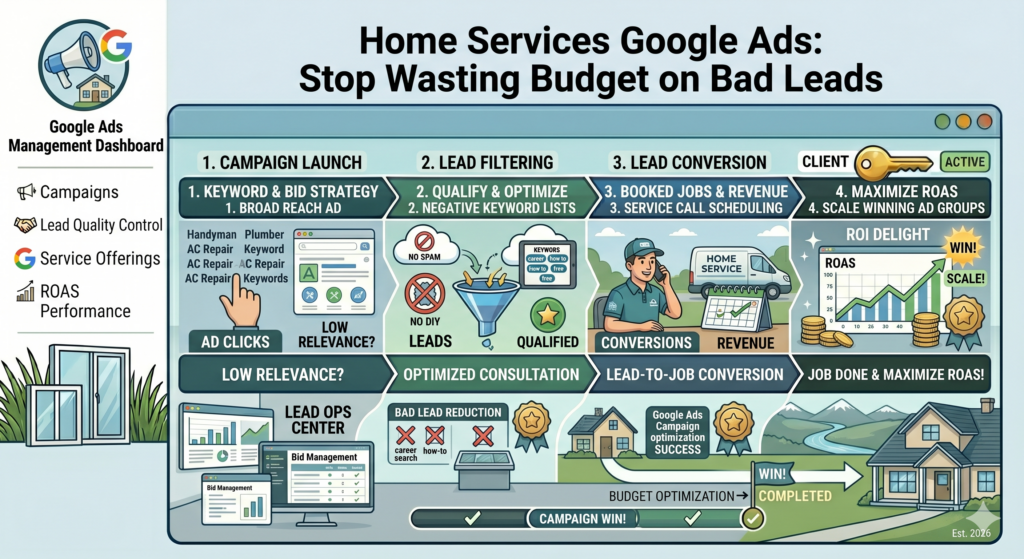
Google Ads for home services is the fastest way to book new jobs and the fastest way to set fire to a marketing budget. Most home services Google Ads accounts quietly waste 25% to 50% of their spend on unqualified clicks, mismatched intent, and leaks that never show up in the headline reporting. This guide walks through where the money actually leaks, how to spot it in your own account inside an hour, and the fixes that usually pay for themselves in 30 to 60 days.
The pressure is real. Industry benchmarks across thousands of home services campaigns put average cost per click at roughly $8 and average cost per lead near $90 in 2025, and electricians, roofers, and painters all run higher. At those numbers, even small waste adds up to thousands of dollars a month.
Why Google Ads for home services are different from other industries
Home services Google Ads have unusual mechanics. Intent is almost always urgent and local, but the keyword set is polluted with low-intent research queries, DIY content, and commercial-only searches that don’t match residential businesses. That means broad match campaigns that would work fine for an e-commerce brand will burn a plumber’s budget in a week. Precision matters more here than in almost any other category.
There’s also a Local Services Ads factor. LSAs now sit above regular Google Ads in eligible home services categories, and they charge per lead instead of per click. Any Google Ads strategy that doesn’t account for how LSAs interact with classic search is already behind.
The top eight budget leaks (and how to plug each one)
Most Google Ads audits for home services find the same eight problems. Fix these first.
1. Broad match without aggressive negative keywords.
This is the single biggest waste driver. Broad match matches your ads to loosely related searches, which sounds efficient and isn’t. A plumber running broad match on “drain cleaning” will show up for “drain cleaning tools,” “how to clean a drain DIY,” “drain cleaning jobs,” and dozens of other terms that will never book a service call. The fix is to either run phrase match with a curated list or run broad match only with a weekly negative keyword review. Both work. One or the other is mandatory.
2. Missing service area discipline.
A contractor in Buffalo serving a 30-mile radius does not want clicks from homeowners 90 miles away. Yet default Google Ads location targeting often includes “people interested in” your target area, which can include travelers, transplants, and people researching from outside the service area. Tighten the radius, set location targeting to “presence” instead of “presence or interest,” and exclude anywhere you don’t actually serve.
3. Weak landing pages.
Sending all your paid traffic to your home page is a conversion killer. Every ad group should point to a dedicated landing page that matches the search intent. “Emergency AC repair Tucson” should land on a page with a phone number above the fold, a short form, trust signals, and local content. Not on your generic services page.
4. No call tracking.
In home services, 84% of marketers report phone calls convert at higher rates than other engagement types. If you can’t attribute calls to the keyword that drove them, you’re optimizing blind. Every campaign needs a dynamic number insertion or a dedicated tracking number, and conversion actions need to count calls that last longer than 60 seconds.
5. Underusing Local Services Ads.
For eligible categories (HVAC, plumbing, electrical, roofing, cleaning, pest control, lawn care, and others), LSAs are almost always the first dollar spent. They pay per lead, not per click, which removes the biggest waste driver in search. If you’re running classic Google Ads but haven’t invested in LSA setup and optimization, you’re spending more for lower-quality leads than you need to.
6. Over-bidding on branded defense without reason.
Some branded campaign is smart, especially if competitors bid on your name. But many home service businesses spend 20%+ of budget defending branded terms when there’s no actual threat. Check the search terms. If competitors aren’t bidding aggressively on your name, dial branded spend way back.
7. Weak ad copy with no urgency or local signal.
“Quality HVAC Services” is invisible. “24/7 Emergency HVAC in Cincinnati | Same-Day Service” is specific, local, and urgent. Small copy improvements on high-volume ad groups often lift click-through rates by 30% or more, which directly lowers CPC through improved quality scores.
8. Not measuring booked jobs.
The cleanest symptom of a troubled account. If your reporting stops at “leads” without walking through to booked jobs and revenue, you’ll happily scale campaigns that generate cheap tire-kicker leads and starve campaigns that generate expensive but profitable jobs. Get a CRM or a spreadsheet and track booked jobs by source. Everything else flows from that.
How to audit your own account in under an hour
Open Google Ads. Pull up the Search Terms report for the last 30 days. Sort by cost. Scan the top 20 searches that cost the most money. How many of those queries would actually book a job? If more than three are junk, you have a negative keyword problem.
Open your Location settings. Are you targeting “presence or interest” or “presence”? Switch to presence. Are any service areas selected that you no longer cover? Remove them.
Check your landing pages. Open each active ad in incognito, click through, and grade the landing page: Does the H1 match the search? Is the phone number visible without scrolling? Is the form under seven fields? If any answer is no, you have a landing page problem.
Pull your conversion actions. Are phone calls set up as conversions? Are only calls longer than 60 seconds counted? If not, you have a measurement problem.
Most home service accounts can identify $500 to $5,000 a month in waste within 60 minutes of auditing.
Where Google Ads fits inside the bigger marketing picture
Paid search is one lever of a broader channel mix. Strong Google Ads without strong local SEO, review velocity, and a converting website will still underperform. The trade-offs between PPC vs. organic SEO come up in almost every home services account, and choosing the right home services marketing agency means picking a partner who can run all of it together.
Trade-specific playbooks for electrician marketing, home remodeling marketing, and window replacement marketing each have unique keyword structures and intent patterns worth understanding in detail.
If your Google Ads account is quietly burning budget and you want a second set of eyes, book a free audit, and we’ll show you exactly where the leaks are. Wrangler Digital partners with home services businesses on Google Search Ads management and typically finds 20% to 40% waste inside the first account review.