

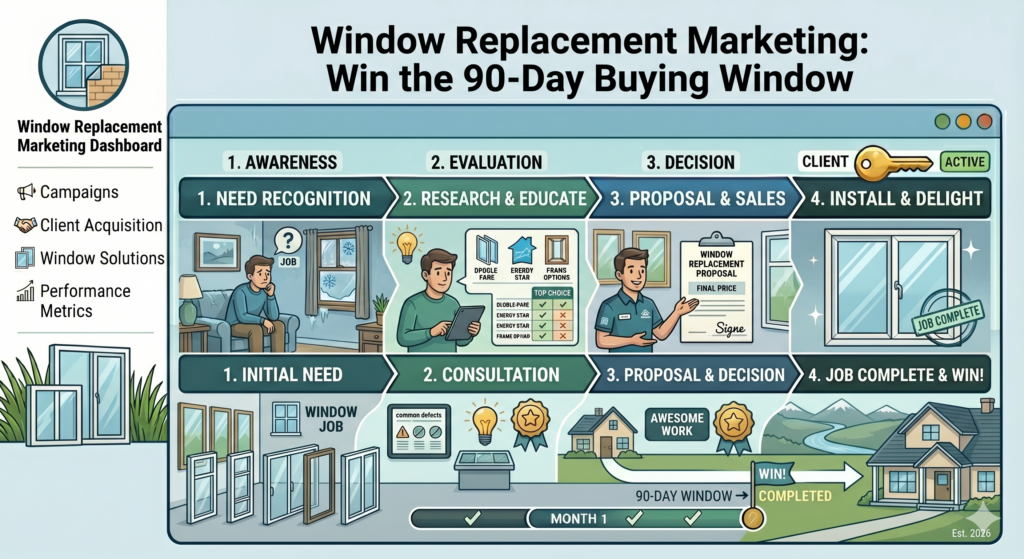
Window replacement marketing is one of the highest-ticket, longest-cycle plays in home services. Homeowners typically spend 60 to 90 days researching before signing, and the average whole-home vinyl replacement project runs $20,000 or more. That combination (high ticket plus long consideration) means your marketing has to do two things at once: stay visible during the evaluation window and build enough trust to win the sale when the homeowner finally picks up the phone. This guide covers how to do both.
Why window replacement marketing is different from other home services
Three things separate window and door replacement from other trades.
The ROI math is unusually public. The Journal of Light Construction’s 2025 Cost vs. Value Report confirms that exterior replacement projects consistently deliver the highest ROI among remodeling projects, with steel entry doors, manufactured stone veneer, and garage doors leading the list. Homeowners know this and increasingly research ROI before pulling the trigger. Your marketing should speak to resale value alongside comfort and energy savings, because those are the three rationales homeowners anchor on.
Climate drives urgency. In markets like Buffalo and Cincinnati, a single brutal winter can turn a deferred window project into a priority. In Tallahassee and New Orleans, hurricane-resistant impact windows have their own seasonal demand curve. Your marketing calendar should match your climate, not the national average.
Financing is part of the sell. Unlike a $400 service call, few homeowners write a check for a $25,000 window replacement. Financing offers, monthly payment framing, and energy-efficiency tax credits are all part of the conversion path. If your website doesn’t address financing prominently, you’re losing mid-funnel homeowners to competitors who do.
The keyword strategy: intent over volume
Window replacement keywords are split into three categories worth treating differently.
High-intent transactional (“window replacement near me,” “window installer [city],” “replacement window companies [city]”) are the most valuable and most expensive. Budget hard here. These searches are close to the sale.
Research and comparison (“best replacement windows 2026,” “vinyl vs fiberglass windows,” “cost to replace windows in [city]”) have moderate intent but much lower costs per click. Your content strategy should dominate these because they fill the top of a long funnel.
Problem and symptom keywords (“drafty windows,” “condensation between window panes,” “why are my windows fogging”) are cheaper still, and they identify homeowners who have just noticed the problem that’s going to lead them to replacement in 30 to 90 days. This is your retargeting audience goldmine.
Why retargeting does more work here than anywhere else
Because the consideration window is so long, retargeting is arguably the single highest-ROI channel in window and door marketing. A homeowner who reads your “vinyl vs fiberglass” blog post in February may not pull the trigger until June. Without retargeting, you paid for that click and got nothing. With retargeting, you stay in front of that homeowner for weeks, adding portfolio photos, financing offers, and case studies to their feed until they come back ready to buy.
Targeted display ads are arguably the single highest-ROI channel in window and door marketing because of how predictable the consideration window is. Audience structure, creative rotation, and frequency capping (the mechanics behind how targeted display ads work) all directly affect cost per booked install.
Google Business Profile and local SEO for window companies
Primary category matters. “Window installation service” is direct. “Window supplier” reads retail. Pick based on your primary revenue stream. Populate services granularly: vinyl window replacement, impact window installation, bay window installation, patio door replacement, entry door replacement, storm door installation, fiberglass window installation. Each one is a ranking opportunity for homeowners searching for specific products.
Photos matter a lot. Upload before-and-after shots of completed installs, with location tags where possible. A homeowner searching “window replacement Cincinnati” is far more likely to click a profile showing actual Cincinnati installs than a profile with stock imagery.
Post weekly. Seasonal promotions, financing announcements, energy-efficiency tax credit information, and completed project photos all keep the profile active.
Reviews and the trust stack for big-ticket purchases
When a homeowner is about to spend $20,000 to $40,000 on windows, they read reviews carefully. Review volume matters, but review detail matters more. A ten-word “great job” review does less than a 150-word review that names the installer, describes the process, and mentions financing.
Systematize review requests at project completion, and specifically encourage clients to mention the products they chose (“Pella vinyl double-hung,” “Andersen casement”), the process (consultation, measurement, install day), and any financing they used. Those keywords surface in long-tail searches and do double duty for SEO and conversion.
Video testimonials work unusually well here. A two-minute video of a homeowner in their kitchen explaining why they picked you converts better than almost any other piece of marketing creative in the category.
Paid search and the landing page discipline
Paid search for windows is expensive. Cost per lead in this category routinely runs in the $80 to $180 range, with higher numbers in competitive metros. The difference between a profitable paid search account and one that quietly bleeds money comes down to landing page discipline.
Each ad group should point to a dedicated landing page matching the search intent. “Impact windows Tallahassee” should not land on your generic home page. It should land on a Tallahassee-specific impact window page with hurricane photos, financing offers, the local building code note, and a short consultation-request form.
The common failure modes drain budgets across every trade in Google Ads for home services, and the fixes are mostly account hygiene: tighter match types, deeper negative-keyword lists, and dedicated landing pages for each ad group.
Financing as a marketing message, not just a checkout option
Most window replacement websites mention financing on a secondary page. That’s a mistake. Financing is an acquisition lever, not just an afterthought. Homeowners doing math on replacement are thinking in monthly payments, not total project cost. Every landing page should carry monthly payment framing (“whole-home replacement for $289/month”) above the fold, with a disclaimer and a link to details.
Energy-efficiency tax credits and state rebates are separate levers that deserve their own prominent placement. A homeowner who doesn’t know about the federal Energy Efficient Home Improvement Credit might pull the trigger if you tell them.
How window replacement fits within remodeling marketing
Many window and door companies also sell themselves as partners to general remodelers or as single-service specialists. The broader category of home remodeling marketing shares a lot of the same principles around long sales cycles, retargeting, and portfolio-driven trust-building, so if you offer adjacent services the strategies compound.
How this fits into the bigger marketing picture
Window replacement marketing is one of the higher-ticket plays in home services, but it still lives inside a broader decision about channels, budget, and agency selection. Choosing the right home services marketing agency means knowing how to evaluate partners, what to budget, and how to measure real ROI instead of vanity metrics.
Ready to capture more high-intent leads? Schedule a free consultation and we’ll audit your current window replacement marketing, including paid search, retargeting, and your conversion funnel. Wrangler Digital partners with home services businesses on paid search, retargeting, local SEO, and landing page optimization.