
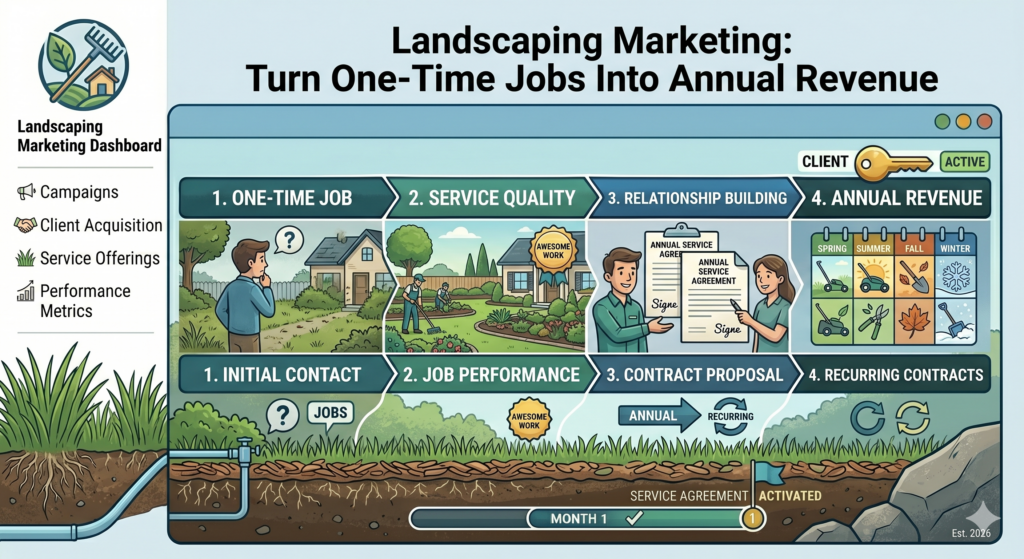
Landscaping marketing is how lawn care, hardscaping, and design-build companies generate steady local leads, with a strong emphasis on visual-first content, recurring-contract acquisition, and seasonal campaign planning. In a U.S. market with nearly 693,000 competing landscape businesses generating $188.8 billion in 2025, what separates the winners from the rest isn’t price or service quality. It’s a marketing engine built around the three defining truths of the trade: it’s intensely visual, increasingly recurring, and brutally seasonal.
Most landscaping marketing plans ignore at least one of the three and pay the price.
Why landscaping marketing is different from other trades
Three things set the green industry apart.
Landscaping is the most visual home services category. Homeowners don’t hire landscapers based on word count. They hire based on photos of completed work that look like what they want their yard to become. That makes Instagram, Pinterest, Facebook, and your Google Business Profile photo library the single most important assets you own. If your competitors have 200 portfolio photos and you have 15, you lose.
Recurring revenue changes the math. The shift toward subscription-style maintenance contracts is real. Industry analysts report that subscription-style maintenance contracts now account for a growing share of new residential bookings at leading landscaping companies, because homeowners want predictable budgeting and automated scheduling. That shifts the economics of a new customer from a one-time $500 cleanup to a $4,800 annual recurring client. Your marketing should be built around acquiring recurring customers, not one-off jobs.
Seasonality dictates everything. In most markets, April and October are peak acquisition windows. January and July (depending on your climate) are dead zones. A marketing plan that spends the same amount every month is wasting money half the year. Front-load budget into pre-season awareness campaigns, protect peak-month paid spend from auction price spikes, and use off-season months for content creation, review outreach, and web improvements.
Sorting landscaping keywords by intent
Landscaping keywords are split into four buckets, each with different economics.
Maintenance keywords (“lawn care near me,” “landscaping service [city],” “weekly mowing service”) have strong intent and lead directly to recurring contracts. These are your most valuable searches.
Design and build keywords (“backyard landscape design,” “hardscaping contractor,” “paver patio installation”) have higher ticket values but longer sales cycles and lower conversion rates. Budget these separately and expect a 30 to 60 day close window.
One-time project keywords (“fall cleanup,” “tree removal,” “sod installation”) are seasonal spikes. These are great for filling crews in shoulder seasons, but don’t build recurring revenue.
Problem keywords (“why are there brown patches in my lawn,” “how to kill crabgrass in Tallahassee”) are educational traffic. Lower conversion, but cheap, and they feed email nurture and retargeting beautifully.
Build separate campaigns, landing pages, and content tracks for each bucket. Don’t mix them.
Google Business Profile for landscaping
Photos do the heavy lifting here. Upload at least 40 high-quality portfolio photos, geotagged where possible, showing a variety of project types: maintenance work, full installs, hardscaping, seasonal cleanups, and irrigation systems. Replace or add new photos monthly. Google’s local algorithm weights photo activity as a signal of business vitality.
Category selection matters. Primary category choices like “lawn care service,” “landscape designer,” “landscape contractor,” or “gardener” each trigger different search behaviors. Pick your primary based on the service that drives your highest margin, then add secondary categories for the rest.
Populate the services section with granular offerings: weekly lawn maintenance, seasonal cleanup, mulch installation, irrigation repair, hardscape design, outdoor lighting, tree trimming, and sod installation. Each one is a ranking opportunity, and homeowners searching for specific services will find the right listing.
Paid search, social, and visual-first ads
For landscapers, paid social is unusually valuable. Facebook and Instagram are where homeowners actually browse inspiration, and before-and-after carousels generate engagement and leads at a fraction of paid search costs. Lookalike audiences built off past recurring-maintenance customers consistently outperform cold targeting. A managed social media advertising program for landscapers prioritizes before-and-after visual content over polished brand assets, because homeowners want to see what your crew actually produces.
Google Ads still matters for high-intent searches, especially “landscaping near me” and specific service queries. Use Local Services Ads where your market supports them. Add aggressive negative keywords: “DIY landscaping,” “landscaping jobs,” “landscaping school,” and anything commercial-only if you only serve residential.
Match-type discipline, aggressive negative keyword lists, and well-built landing pages are the foundation of profitable Google Ads for home services campaigns across every trade, landscaping included.
Reviews and the trust engine
Reviews drive bookings in landscaping more than most owners realize. Homeowners are inviting crews onto their property, sometimes weekly, so they want to see consistency. Review velocity matters: five new reviews a month beats 50 reviews from two years ago for ranking purposes.
Build a systematic request process into your job-completion workflow. A text message with a direct Google review link sent the day after each completed visit converts at 15% to 25%. Respond to every review, positive or negative, within 48 hours.
Recurring revenue: the content and offer strategy
If you’re building toward a subscription model, your marketing has to sell the subscription, not the one-time job. That means website offers like “Full-Season Lawn Care for $180/month” instead of “Get a Quote.” It means email nurture that demonstrates the cumulative value of a maintained yard. It means case studies of clients on year three of maintenance plans whose properties look noticeably better than their neighbors.
The one-time-job homeowner is a different audience than the annual-contract homeowner. Your paid campaigns should segment these, with different landing pages, different offers, and different creatives.
Cross-trade opportunities and outdoor electrical
Landscapers increasingly partner with electricians for outdoor lighting installs and generator hookups, or handle light electrical work themselves, depending on licensing. If outdoor lighting is a significant revenue stream, the keyword strategy in electrician marketing for landscape lighting and EV charger installs often overlaps with the same customer.
How landscaping marketing fits the broader strategy
Landscaping marketing isn’t a standalone effort. It’s one piece of a channel strategy that has to balance organic search, paid search, social, email, and reviews across a seasonal calendar. Picking the right home services marketing agency means understanding budget ranges, channel mix, and what to ask before signing with any partner.
Ready to fill crews year-round? Schedule a free consultation, and we’ll audit your current landscaping marketing, then build a plan that targets recurring contracts instead of one-off jobs. Wrangler Digital partners with home services businesses on local SEO, paid search, and content strategy.