
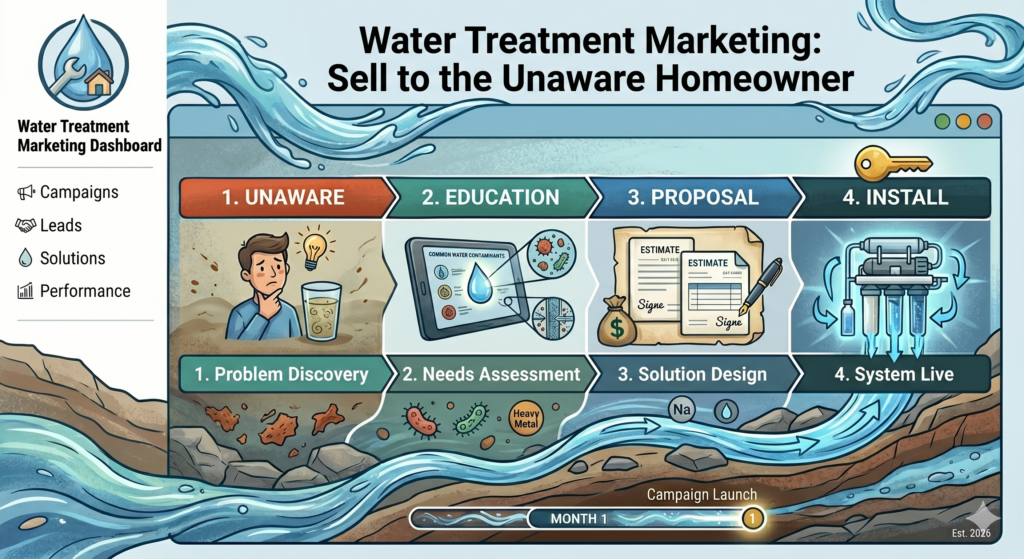
Water treatment marketing is the practice of selling water softeners, filtration systems, and reverse osmosis equipment to homeowners who often don’t know they need them. Unlike a broken AC or a leaking pipe, hard water rarely creates an emergency that drives a Google search. The marketing job is to create problem awareness first, then convert it into a free in-home water test, then close the install. Companies that get this sequence right build predictable install pipelines. The ones that don’t get stuck fighting for the same urgent-intent keywords as plumbers and burning through budget.
Why water treatment marketing is different from other home services
Three things set this category apart.
Demand is latent, not active. Homeowners in Las Vegas, Albuquerque, Tucson, and El Paso live with some of the hardest water in the country, but most have normalized it. Spots on glasses, mineral buildup on faucets, dry skin, short appliance lifespans: these are treated as background noise, not problems. That means search volume for “water softener near me” is a fraction of what you’d expect given the actual need. Your marketing job is to connect observed symptoms to a named cause.
The market is growing fast. The U.S. water softening systems market was valued at $716.3 million in 2024 and is projected to reach $763.6 million in 2025, with forecasts pointing to $1.19 billion by 2032 according to Fortune Business Insights. Smart home integration, rising awareness of water quality issues, and consumer preference for whole-home filtration are all pulling demand forward. But competition is pulling in at the same time, so showing up first and educating best is how you win.
The sales cycle is longer than plumbing but shorter than remodeling. Homeowners typically consider water treatment for 30 to 90 days. Many move forward only after a free water test or in-home demo converts them. That means your marketing has to generate appointments, not just phone calls.
The funnel: from symptom to install
Water treatment marketing works best when it’s structured around a specific homeowner journey. Here’s how to build each stage.
Problem awareness content. Blog posts, short-form videos, and social content that name the symptoms homeowners ignore.
- “Why your shower glass always looks cloudy in Tucson.”
- “What causes the white residue on your faucet in Albuquerque.”
- “Are you really shampooing wrong, or is your water hard?”
These posts do two jobs: they rank for specific symptom queries, and they create the “aha” moment that drives next-step action.
Solution awareness content. Now the homeowner knows they have a problem. The next layer of content explains options: salt-based softeners, salt-free conditioners, reverse osmosis, whole-home filtration. Guides that compare options, discuss costs, and explain installation turn passive interest into active research.
Free water test offer. This is the offer that converts. A free in-home water test creates commitment and puts a technician in the homeowner’s house, where demos close at 30% or higher in most markets. Your paid search, landing pages, and email nurture should all funnel toward this single offer.
Post-install referral flywheel. Water treatment customers have neighbors with the same water. A systematic referral program with modest incentives (prepaid salt deliveries, filter change discounts) turns one install into two or three over 18 months.
Paid search, display, and the right keyword mix
Paid search for water treatment needs to be split across two intent buckets. High-intent transactional keywords (“water softener installation,” “best water filter for well water,” “whole home water filtration”) are where you compete directly. These are expensive but convert. Research-stage keywords (“is hard water bad for skin,” “how to test water hardness at home”) are cheaper and slightly lower on conversion, but they fill the top of your funnel and let retargeting do the heavy lifting later.
Display and retargeting punch above their weight here. Because the consideration window is 30 to 90 days, a banner ad showing up the third week after a homeowner reads your “signs of hard water” article can close the loop at a much lower cost than trying to buy that same homeowner with paid search a second time.
If your current paid search budget is getting eaten up by broad keyword matches and low-intent clicks, the same patterns that drain Google Ads for home services across other trades show up in water treatment campaigns too. The fixes are mostly account hygiene.
Google Business Profile and local SEO
For water treatment companies, Google Business Profile category selection matters a lot. “Water softening equipment supplier” signals commercial intent. “Water filter supplier” reads retail. The right primary category depends on whether you primarily install, primarily sell equipment, or do both. Most companies pick the default and never revisit.
Populate your services list with every specific offering: water softener installation, reverse osmosis installation, whole-home filtration, salt delivery, filter replacement, water testing. Post weekly with educational content, customer stories, and before-and-after photos of installs (clean glass, cleaner laundry, intact appliance components).
Reviews: the trust multiplier
Homeowners don’t usually read reviews for a plumber they call during an emergency. They absolutely read reviews for a water treatment company they’re about to pay $3,000 for a system. Your reviews are where the objection-handling happens before the call.
Make a systematic process for requesting reviews after every install. Encourage customers to mention specifics: the water test, the in-home consultation, the installer’s professionalism, how quickly they noticed a difference. Those specifics rank for long-tail queries and build genuine trust.
Website conversion: the in-home water test as hero offer
Most water treatment websites bury the conversion offer. Fix that. Your home page, every service page, and every blog post should make the free in-home water test the primary call to action above the fold. The form should be short (name, address, phone, preferred time window). Every page should have a tap-to-call number for homeowners who prefer to just talk.
Add a simple hardness calculator or quiz (“How hard is your water? Answer three questions”) that collects email addresses. It’s the single easiest way to turn research-stage traffic into leads you can nurture through email. A focused web design and development effort often pays back in months for water treatment companies, because every conversion improvement compounds across both organic and paid traffic.
How this fits into the bigger marketing picture
Water treatment marketing is one piece of a larger channel strategy. If you’re also running plumbing, HVAC, or whole-home service offerings, the integration between campaigns matters a lot. Choosing the right home services marketing agency means understanding how to align channels, set budgets, and measure what actually produces booked installs.
Ready to fill your install pipeline? Book a free consultation, and we’ll audit your current water treatment marketing, then map where your biggest install-pipeline opportunities are. Wrangler Digital partners with home services businesses on local SEO, paid search, and educational content strategy.